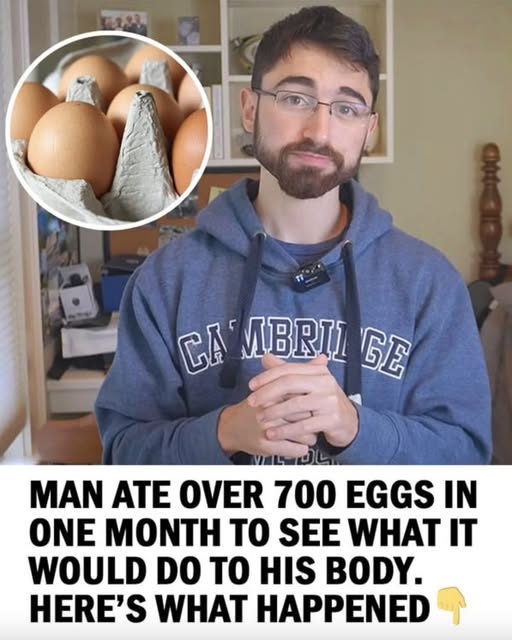
It all started with a hypothesis that his cholesterol levels won’t level up, and ended with the consumption of whooping 720 eggs in just a month, equaling to 24 eggs per day.
Yes, you’ve heard that right. Medical student Dr. Nick Norwitz decided to undertake an interesting “eggsperiment” that he documented in a YouTube video.
Addressing his followers, Dr. Norwitz said he believes that consuming 60 dozen eggs won’t affect the levels of his cholesterol, especially the LDL cholesterol, or the “bad cholesterol,” despite the fact that 720 eggs “amounts to 133,200 MG of cholesterol.”
In order to prove his theory right, he ate an average of one egg per hour for an entire month.
The results? Well, put into Dr. Norwitz’s wods, they were jaw-dropping.
“Even though my dietary intake of cholesterol more than twintupled, my LDL cholesterol actually dropped by two percent over the first two weeks,” he explained.
Over the following two weeks, the levels of his LDL cholesterol dropped an impressive 18 more percent.
Now, if you wonder how that is possible, since teachers taught us that cholesterol-rich foods increase the levels, Dr. Norwitz provides an answer.
“Basically, when you eat cholesterol it ‘binds to receptors on gut cells and this stimulates the release of a hormone called chisin and chisin binds to its receptor on the liver called GPR1 146 and this inhibits endogenous cholesterol synthesis by the liver so things balance out and the homeostasis is maintained,” he said.
“The purpose of this whole experiment was a metabolic demonstration to discuss the ‘levers’ that can affect cholesterol in different individuals,” the cell biologist metabolism scientist who’s pursuing medical degree at Harvard.
“I expected my cholesterol levels not to change by just adding the eggs — and that is indeed what happened.”
Dr. Norwitz, who has done a number of experiments in order to show his interest in metabolic health, further explained that there is no a universal “best” diet.
Please SHARE this article with your family and friends on Facebook.
Leave a Reply