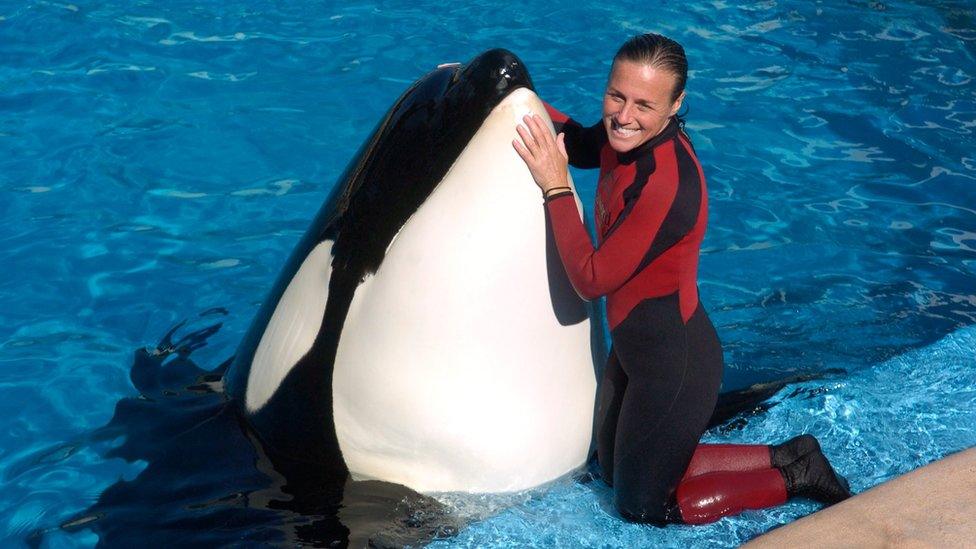
Disclaimer: This story is a dramatized feature inspired by real-world discussions on marine animal captivity and welfare. Names, events, and settings are fictionalized for narrative purposes.Star Orca Neptune Turns on Trainer Mid-Performance: A Wake-Up Call for Marine ParksWhen hundreds of spectators gathered at the Blue Horizon Marine Arena last weekend, they expected laughter, splashes, and awe. What they witnessed instead was a moment of terror — and a powerful reminder of nature’s untamed strength.Neptune, the park’s celebrated orca, long known as the “Gentle Giant of the Ocean,” suddenly turned on his trainer mid-performance, transforming a spectacle of joy into a scene of chaos.
Phones fell silent. Children cried. The crowd that came for wonder left shaken — and questioning whether creatures born to roam the deep sea truly belong in tanks.The Day the Show Fell ApartThe performance began like any other: booming music, synchronized leaps, and a dazzling display of marine agility. Neptune soared through the air, water glittering beneath the lights. Then, in a blink, everything changed. Witnesses reported that the six-ton orca veered off course, lunging toward his trainer in an unprovoked act that left onlookers gasping. Security teams reacted within seconds, pulling the injured trainer to safety. Thankfully, the wounds were serious but not fatal.
Still, the emotional impact rippled far beyond the water.“How could something so intelligent, so loved, just snap?” one visitor asked. But experts say the question isn’t why Neptune attacked — it’s why we keep expecting he won’t.Why Captivity Changes EverythingMarine biologists and animal behaviorists have long warned about the psychological effects of captivity on orcas. These apex predators, capable of traveling up to 100 miles a day in the wild, are confined to tanks barely large enough for a few body lengths.Years of limited space, artificial routines, and separation from their pods can lead to profound stress.
What the public often sees as “playful performance” may actually be a coping mechanism for boredom, anxiety, or depression.The Neptune incident isn’t isolated. In 2009, an orca named Keto killed his trainer during a show in Spain. In 2010, Tilikum — the orca at the center of the documentary Blackfish — was linked to the deaths of three people.While each case has unique circumstances, the underlying theme remains the same: wild instincts and emotional trauma often collide in captivity.The Illusion of ControlFor decades, marine parks have presented orcas as majestic entertainers — intelligent, trainable, even affectionate. But these displays mask a deeper truth: animals built for the open ocean cannot thrive behind glass walls.In captivity, orcas develop abnormal behaviors: grinding their teeth on tank walls, floating listlessly for hours, or showing aggression toward other whales and humans. Trainers form deep bonds with these creatures, yet even love and expertise cannot erase the psychological toll of confinement.
What happened with Neptune wasn’t just a tragedy; it was a message. A reminder that no matter how much training, conditioning, or affection we offer, nature’s will is not ours to command.The Broader Conversation: Ethics and AwarenessPublic perception is shifting. Following Blackfish, several countries and U.S. states introduced stricter regulations on marine mammal captivity. Canada banned breeding and keeping orcas in 2019. Even SeaWorld announced it would end its orca breeding program and phase out live shows.Neptune’s case reignites the debate: are these performances worth the cost?Animal welfare advocates argue that instead of shows, marine parks should focus on rehabilitation, ocean education, and virtual experiences that inspire without exploiting. After all, fascination with nature shouldn’t require its suffering.
Final Reflection: The Tank Isn’t the OceanAs Neptune’s story makes headlines, one truth stands above all: the sea is not a stage, and its creatures are not actors.The trainer survived, but the event left a lasting scar — a reminder that even the most carefully controlled environments can’t contain the instincts of a creature born free.Perhaps it’s time we trade applause for awareness, and shows for sanctuaries.Because if a single moment of rebellion from a captive orca can move us this deeply, maybe it’s not Neptune we should fear — but what his silence was trying to tell us all along.Sources:National Geographic: “Why Captive Orcas Are Struggling to Survive”BBC Earth: “Tilikum and the Tragedy of Captive Whales”Smithsonian Ocean: “The Truth About Orcas in Captivity”
Leave a Reply