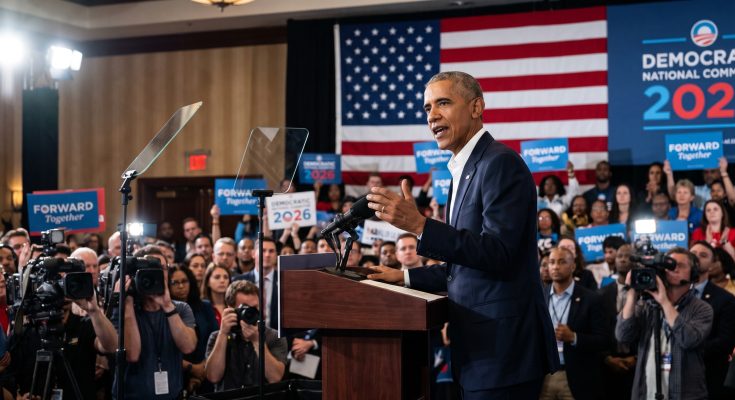
WASHINGTON — In an unsparing post-election address that cut through the lingering din of national vote-counting, former President Barack Obama delivered a sharp, comprehensive indictment of the Trump administration, characterizing the midterm election results as a definitive public repudiation of the White House’s executive conduct, economic vision, and governing ethos.
Speaking from Washington as certified returns solidified key congressional majorities and reshaped gubernatorial executive mansions across vital battleground states, Obama presented the electorate’s verdict not merely as a standard partisan recalibration, but as a deliberate institutional check engineered by voters exhausted by years of political turbulence.
“This election was our best chance to rein in the foolishness of this administration,” Obama declared, reprising a resonant refrain that had anchored his final, high-energy appearances on the campaign trail from Michigan to Georgia. “These are serious times. We need serious people in Washington and in our state capitals—not reality television, not manufactured chaos, and not perpetual division.”
Obama’s post-mortem carried the weight of an elder statesman stepping into the operational fray. Having spent weeks barnstorming competitive suburban corridors and working-class strongholds, the former president argued that voters had systematically rejected the premise that governance should mirror a transactional spectacle. Instead, he framed the outcome as an urgent democratic mandate for institutional decorum, executive restraint, and long-delayed policy accountability.
A central pillar of Obama’s remarks focused on the economic anxieties that dominated kitchen-table discussions throughout the cycle. He systematically dismantled the administration’s economic platform, zeroing in on protectionist trade strategies and unilateral tariff regimes that critics contend exacerbated inflationary strain on middle- and lower-income families.
“Working families cannot pay their groceries with nationalistic soundbites,” Obama said, emphasizing that protectionist trade disruptions had compromised consumer purchasing power rather than delivering promised domestic revitalization. He argued that the White House had misdiagnosed economic fundamentals, using blunt trade instruments that prompted international retaliations while doing little to insulate domestic payrolls from systemic disruption.
Beyond structural economic critique, Obama turned a spotlight onto the moral tone of the executive branch, targeting what he described as a creeping commercialization of public office. He argued that the boundary between national stewardship and self-serving deal-making had been systematically eroded under President Trump, alienating moderate voters and institutional conservatives who prioritize constitutional ethics over partisan alignment.
“Public office is a sacred public trust, not an apparatus for private brand management or family enterprise,” Obama stated. He asserted that the electorate’s decision to shift the balance of legislative authority reflected a deep-seated public fatigue with governance driven by self-enrichment and personal grievance.
While directing his sharpest critiques at the West Wing, Obama struck an institutionalist tone in commending the civil servants, poll workers, and civic volunteers who safeguarded the integrity of the ballot. Amid months of preemptive attacks on voting infrastructure, the former president lauded the resilience of local election boards, remarking that the peaceful, efficient operation of the democratic process proved that civic norms remain resilient despite polarizing national rhetoric.
Reacting to the shifting political map from the White House, President Trump offered a combative yet measured assessment. Speaking before press cameras following the certified tallies, Trump formally acknowledged the opposition’s gains, conceding their aggressive campaign coordination while simultaneously pivoting to critique rival messaging strategies and localized candidate performances. He warned that divided governance risked partisan paralysis, though he expressed confidence in his administration’s ability to defend its legislative legacy.
The resulting political realignment sets the stage for a period of intense legislative friction. With opposition lawmakers now positioned to take control of key House and Senate gavels, the capital is bracing for aggressive investigative oversight, including revived subpoena powers aimed at executive spending, regulatory changes, and regulatory enforcement.
Obama’s post-election remarks effectively lay out the narrative blueprint for this renewed institutional counterweight. By framing the election results as a moral and structural reckoning, the former president positioned the reconstituted legislative branch not as an obstructionist force, but as an essential constitutional corrective poised to shape the national agenda heading directly into the next presidential campaign.
Leave a Reply