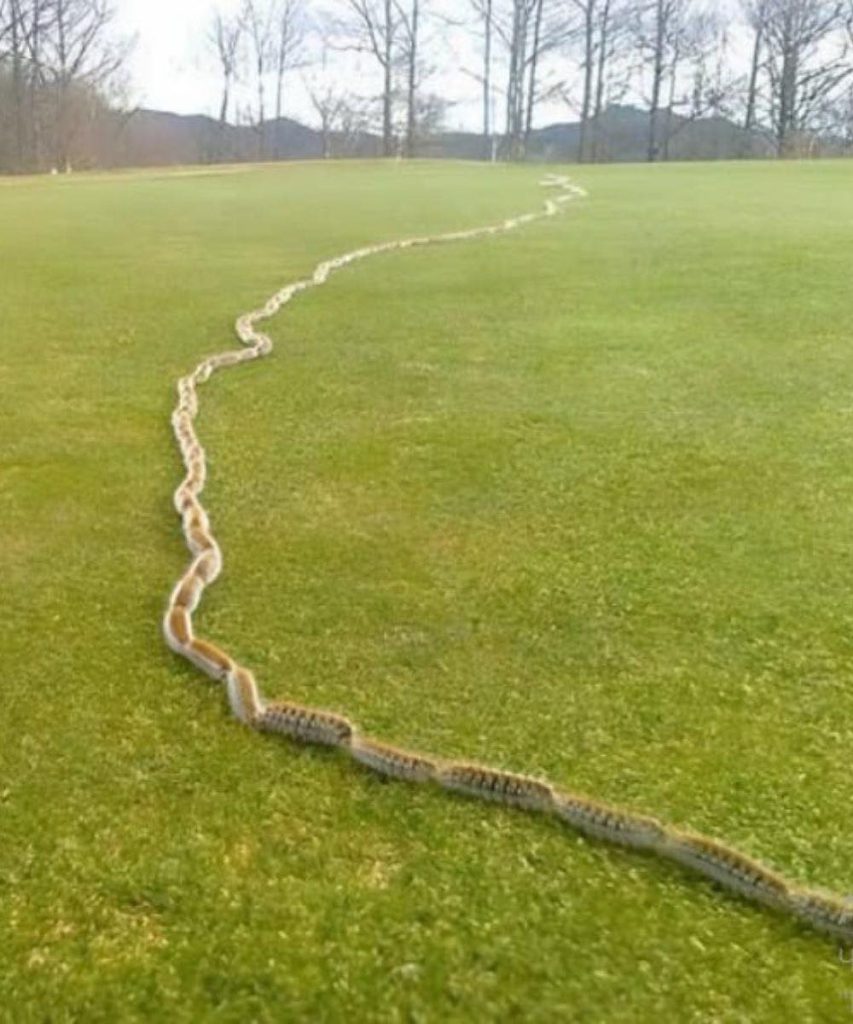
It began as an ordinary walk through the yard on a quiet afternoon. The grass swayed gently in the breeze, and everything seemed perfectly normal until something unusual caught my eye.It wasn’t a rope.
It wasn’t a snake.
It was an astonishing line of caterpillars.
A Living Chain of Tiny Travelers
Stretching across the grass was a procession of roughly 150 caterpillars moving together in a remarkably straight line.
Each caterpillar followed closely behind the one in front, creating what looked like a single moving ribbon.
I had never witnessed anything like it.
Instead of wandering in different directions as I expected, they stayed tightly grouped, advancing with surprising coordination.
Watching them felt almost hypnotic.
There was no obvious leader giving directions, yet the entire group seemed to move with a shared purpose.
For several minutes, I simply stood there observing one of nature’s most unusual sights.
Why Do Caterpillars Travel in Lines?
Afterward, curiosity led me to learn more about this remarkable behavior.
Scientists have observed that several species of caterpillars naturally travel in organized processions.
Although researchers continue studying the exact reasons, several scientific explanations have been proposed.
One possibility is protection.
When many caterpillars move together, predators may find it more difficult to isolate a single individual. Large moving groups can also appear bigger and more intimidating than a lone caterpillar.
Another explanation involves energy conservation.
Following directly behind another caterpillar may reduce the effort required to navigate obstacles or maintain a consistent path, especially over long distances.
Researchers also believe these processions may help caterpillars locate food more efficiently.
Instead of every individual searching independently, the group benefits from shared movement toward suitable feeding areas.
The precise reason likely varies among different caterpillar species and environmental conditions.
Leave a Reply