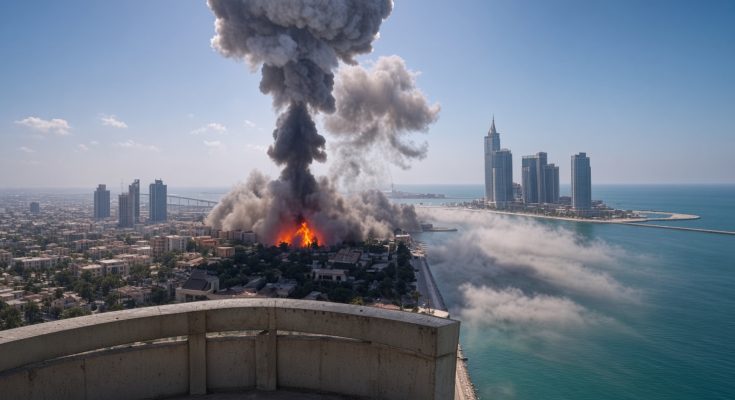
MANAMA, Bahrain — A sharp military escalation between the United States, Iran, and allied regional forces has plunged the Persian Gulf into its most severe security crisis in decades, stranding global commerce, driving crude oil past $100 per barrel, and placing Gulf Cooperation Council (GCC) monarchies on high alert.
The confrontation has turned the Strait of Hormuz—the maritime bottleneck responsible for a fifth of the world’s petroleum transit—into an active theater of war. Commercial traffic has collapsed under a surge of maritime sabotage, drone attacks, and attempted boardings. Shipping data indicates tanker-related security incidents hit a record peak early this month, with at least a dozen verified hostile encounters recorded within a single week.
Daily commercial transits through the corridor fell to just seven vessels on Oct. 6, dragging crude flows down to approximately 10.1 million barrels per day—a 26 percent drop from pre-crisis benchmarks. Despite efforts to route volumes through overland bypass pipelines, surging war-risk insurance rates and carrier cancellations have crippled maritime supply chains, sending shockwaves through global energy markets.
In response, U.S. Central Command (CENTCOM), which oversees more than 50,000 personnel across the theater, has launched extensive air and naval strikes against Iranian coastal command posts, radar installations, drone staging depots, and mobile missile batteries. While Washington frames the campaign as an essential effort to restore freedom of navigation, Tehran has countered with asymmetric strikes, directly endangering the Gulf states hosting critical Western military installations.
For GCC capitals, hosting forward-deployed U.S. forces has created an acute defensive liability:
United Arab Emirates: Al Dhafra Air Base, an operational anchor for Western surveillance and strike missions, faces recurring saturation threats from low-altitude loitering munitions and ballistic missiles aimed at piercing its multi-tier THAAD and Patriot air-defense batteries.
Bahrain: Home to the U.S. Navy’s Fifth Fleet headquarters, the island kingdom faces heightened geographic vulnerability. Dense urban centers, key desalination plants, and commercial infrastructure remain exposed to direct hits and falling interceptor debris.
Qatar: Al Udeid Air Base serves as the forward command hub for CENTCOM operations. Any disruption threatens coalition command-and-control networks, leaving Doha caught between vital security guarantees and securing its offshore liquefied natural gas export infrastructure.
Kuwait: Proximity to northern maritime contested zones leaves Kuwait vulnerable to proxy drone incursions and cross-border missile fire, testing its integrated air-defense networks.
The fallout extends well past military facilities. Flagship airlines across Dubai, Doha, and Abu Dhabi have rerouted long-haul flights away from contested airspace, inflating fuel costs and flight times. Ports are grappling with severe container backlogs as global logistics firms reassess their risk exposure in the lower Gulf.
Caught in an escalating proxy war, Gulf monarchies are walking a precarious line—scrambling to reinforce collective air defenses and preserve American security alliances without triggering a broader regional conflagration that could devastate their economies.
Leave a Reply