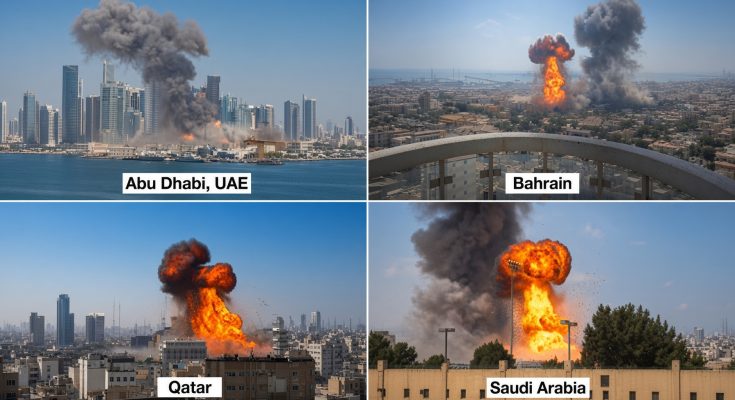
DUBAI / WASHINGTON — Air defense networks across the Persian Gulf were placed on maximum combat alert following a coordinated wave of Iranian ballistic missile and one-way attack drone volleys targeting military installations hosting American personnel across the United Arab Emirates, Bahrain, Qatar, and Kuwait.
The strikes represent a significant regional escalation, testing the limits of integrated theater air defenses and highlighting the profound strategic risks confronting Gulf Cooperation Council (GCC) member states. By hosting major forward-operating hubs for the United States Armed Forces, these nations find themselves positioned directly on the frontline of the deepening military confrontation between Washington and Tehran.
While regional militaries and U.S. Central Command (CENTCOM) moved quickly to activate surface-to-air missile batteries to counter the incoming threats, the operational aftermath remains obscured by strict military information control. Claims issued by state-aligned media outlets in Tehran detailing extensive damage to strategic targets stand in sharp contrast to initial coalition assessments, which indicate that the vast majority of inbound threats were successfully intercepted outside perimeter security lines.
Critical American Bases Targeted Across the Littoral
In the United Arab Emirates, the primary focus of the aerial assault centered on Al Dhafra Air Base, situated south of Abu Dhabi. The sprawling installation functions as an indispensable hub for U.S. Air Forces Central, hosting advanced combat aviation, intelligence, surveillance, and reconnaissance (ISR) platforms, as well as aerial refueling tankers. Terminal High Altitude Area Defense (THAAD) and Patriot PAC-3 batteries stationed in the sector engaged multiple inbound vectors. While military authorities confirmed that interception debris fell across unpopulated buffer zones, technical crews are conducting runway and radar assessments to rule out structural fragmentation.
Simultaneously, air sirens sounded across the island kingdom of Bahrain, home to Naval Support Activity Bahrain in Manama. The installation houses the operational headquarters of U.S. Naval Forces Central Command and the U.S. Fifth Fleet, which oversees allied maritime security corridors spanning the Red Sea, the Gulf of Oman, and the Arabian Sea. Interceptor units engaged sea-skimming drones and cruise missiles over international waters before they could compromise port facilities, though the sustained threat prompted naval commanders to heighten perimeter force-protection conditions and review warship dispersals.
Leave a Reply